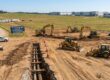

Essential types of earthmoving equipment play a critical role in the success of any construction project, helping to move large volumes of earth and materials quickly and efficiently. From digging deep trenches to grading rough terrains, the right machinery makes all the difference in achieving project goals. Excavators, bulldozers, backhoes, skid-steer loaders, and more are among the most commonly used machines in the industry, each designed for specific tasks. Understanding the unique features and capabilities of these machines ensures that you can choose the right tool for your next project. Continue reading to see the list of essential types of earthmoving equipment
If you’re working on a heavy construction project, you know how crucial the right earthmoving equipment can be. Excavators, for example, are designed to dig deep foundations and move massive amounts of soil.
Excavators come in various sizes, ranging from 5 to 100 tons in weight, and are equipped with a variety of attachments, such as buckets, hammers, and shears. They’re ideal for tasks like trenching, demolition, and site preparation.
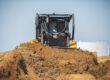
Bulldozers, on the other hand, are perfect for pushing large amounts of soil around a construction site. They’re typically used for grading and leveling tasks, and can be equipped with ripper shanks to break up compacted soil.
Backhoes are another versatile piece of equipment that combines a front-end loader with a backhoe attachment, allowing for both digging and lifting tasks to be performed from a single machine.
Types of Earthmoving Equipment
Excavators are versatile machines that can aid in a variety of tasks, including mass excavation, stockpiling, and digging trenches. They come in different sizes and can dig up to 30 inches or more, making them a valuable asset on any construction site.
Skid-steer loaders are another type of earthmoving equipment that’s perfect for confined spaces or areas with finished surfaces. Their small size and nimble design allow them to turn within their own footprint, and they can be outfitted with various attachments for tasks like digging, drilling, and compacting.
Some popular types of earthmoving equipment include crawler loaders, which are well-suited for moving heavy materials like sand, wood chips, and rock. They feature a tracked chassis and a loader, and can be outfitted with various attachments for different tasks.
Excavators
Excavators are large construction equipment that can be driven by tracks or wheels, but tracks are more standard. They have a long bucket arm attached to a pivoting cab that can rotate a full 360 degrees.
The operator sits in the cab and has good visibility of the site. Excavators are highly versatile and can be fitted with special attachments for specialty jobs.
Some common uses for an excavator include material handling, excavating trenches, holes, and foundations, brush cutting with hydraulic attachments, demolition, rough grading, heavy lifting and pipe installation, mining, and river dredging.
Excavators have different capacities to and excavating depths, and are able to dig up to 30” or more. They are used to complete a variety of applications, including mass excavation, stockpiling, digging trenches, loading trucks, site clean up, backfilling, and lifting.
Here are some of the main benefits of using excavators:
- They come in various sizes and can aid different tasks
- They are a versatile piece of equipment to have on your site
Excavators are heavy-duty construction machines used for digging and lifting materials like dirt and gravel. They feature an adjustable arm with a bucket at the end, controlled by hydraulics to lift and move the materials.
Some popular models of excavators include the CAT 303 CR Mini Hydraulic Excavator, which offers powerful digging performance in a compact size, and the CAT 349 Hydraulic Excavator, which is designed to work in heavier applications than other excavators.
A hydraulic excavator relies on the power of hydraulic fluid, hydraulic cylinders, and a hydraulic motor to accomplish its tasks. Tracked excavators are suitable for digging, material handling, and demolition, while mini-excavators are small and lightweight, making them ideal for trenching and utility work.
Broaden your view: Walking Excavator
Backhoes
Backhoes are one of the most common types of earthmoving equipment. They’re made up of a bucket arm connected to a tractor and are typically used for digging and lifting to move materials such as dirt or gravel.
Most back hoes have an adjustable stabilizer leg at the rear end, allowing them to maintain optimal balance when digging large trenches and holes. Some popular models come fully equipped with front-loading buckets for additional versatility.
The CAT 416F2 Backhoe Loader is a heavy-duty machine that features advanced operator controls and enhanced system durability. It’s ideal for infrastructure construction projects where precision and reliability are key.
Here are some key features of popular backhoe models:
Model and Features
- CAT 416F2: Backhoe Loader Heavy-duty extended life design, advanced operator controls, and enhanced system durability
- CAT 415: Backhoe Loader Advanced hydraulics, low noise levels, and improved boom control systems
- CAT 450F2: Backhoe Loader Heavy-duty extended-life design, state-of-the-art operator controls, and superior system durability
Overall, backhoes are versatile and powerful machines that can tackle a wide range of earthmoving tasks.
Dozers
Dozers are a type of heavy-duty construction machine commonly used on large-scale construction sites. They’re equipped with a front-mounted metal blade that excels at pushing large quantities of soil, sand, rubble, and other materials.
Their tracks provide superior traction and mobility on uneven terrain, making them ideal for challenging environments. Different types of blades, such as S-blade, U-blade, and angle blade, enhance their versatility.
A bulldozer’s main task is to push, level, and move huge loads of debris, such as dirt. They have a variety of uses, including leveling, ripping, demolition, bulk excavation, battering, and benching.
Some popular dozer models include the CAT 814K Wheel Dozer, CAT D8T, and CAT D6 XE Dozer. These models feature powerful engines, improved hydraulics systems, and larger blade capacities than their predecessors.
Dozers are track-mounted, heavy-duty construction machines. They’re designed to handle material-moving projects with efficiency and safety on construction sites.
A unique perspective: Cat D11 Specifications
Skid-Steer
Skid-steer loaders are among the most versatile machines in the construction industry, making them ideal for work in confined spaces.
They can turn within their own footprint, just like a tank, and offer good traction in snow and mud.
The wheels of a skid-steer loader minimize soil compaction and damage to finished areas.
Skid-steer loaders come in a few different sizes and can be outfitted with a variety of attachments to perform tasks such as digging, drilling, and compacting.
The highly rigid frame of a skid-steer loader prevents the torsional forces induced by its dragging motion from damaging the machine.
The wheels of a skid-steer loader are locked in synchronization on each side, allowing the left-side drive wheels to be driven independently of the right-side wheels.
This mechanism enables the machine to turn by skidding, dragging its fixed-orientation wheels across the ground.
Skid-steer loaders have a tough and rigid frame, making them durable and long-lasting.
You might like: Loader (equipment)
Motor Graders
Motor graders are heavy equipment used for fine grading and for moving small amounts of dirt. They have a long blade that can be adjusted to meet certain angles to create a flat surface.
Motor graders typically use three axles, with the cab and engine situated above the rear axles at a single end of the vehicle. The blade is usually located in between the front and rear axles.
Some motor graders drive the rear axles in tandem, but others also put the front-wheel drive to improve grading capability. This can be useful for creating sloped surfaces or drainage ditches with shallow V-shaped cross-sections.
Motor graders are primarily used in civil construction, roadworks, and mining sites to create smooth roads. They can also be fitted with attachments like a ripper, blade, or compactor to make them multipurpose.
On a similar theme: Heavy Equipment Front End Loader
Crawler
Crawler equipment is a vital part of any construction site, offering unparalleled stability and versatility. A crawler loader, for instance, combines the features of an excavator and a backhoe, making it perfect for excavation on smaller projects.
Its tracks provide excellent stability, and the versatile bucket can move soil and debris with ease. Crawler loaders are also used for loading material onto trucks, making them an essential part of any fleet.
Crawler carriers, on the other hand, are designed for transporting heavy cargo and materials on uneven terrain. They’re perfect for construction sites with rough surfaces, and their hydrostatic drives make operation a breeze.
Some popular crawler carriers include those designed for earthmoving and pipeline projects. These carriers offer many benefits, including increased productivity and safety on construction sites.
Here are some key benefits of crawler carriers:
- Increased productivity
- Improved safety
- Enhanced mobility on uneven terrain
Click here to continue reading
Original article published on chelmervalue.com